
Residential Drywall & Stucco Services in Calgary
Residential Drywall & Stucco Services in Calgary
Hanging drywall is the easy part. Taping and mudding is where you find out if your drywaller actually knows what they’re doing.
Every seam, every screw hole, every inside corner — it all gets covered in joint compound and tape during this stage. And if it’s done wrong, you’ll see it. Not right away, maybe. But the first time afternoon light hits that living room wall at a low angle, every bump, ridge, and missed spot shows up like a road map. That’s why we take this phase seriously at RC Stucco and Drywall. It’s the difference between walls that look finished and walls that look done right.
If you’re building new, renovating, or just had drywall installed and need someone to tape and finish it properly — we handle drywall mudding and taping in Calgary for residential projects of all sizes.
Most homeowners don’t know this, but there’s actually a formal grading system for drywall finishes. It runs from Level 0 to Level 5, and each level adds more coats, more sanding, and more labour. The level you need depends entirely on what’s going on top of the drywall — paint, texture, tile, or nothing at all.
Level 0 — No taping, no mudding, nothing. The drywall is hung and that’s it. This only exists for fire-rated assemblies where code requires drywall but nobody’s ever going to see it. Think above a concrete ceiling in a commercial space.
Level 1 — Tape is embedded in joint compound, but that’s it. No smoothing, no second coat. You’ll see tool marks and ridges everywhere. This is standard for areas that are out of sight — above ceilings in garages, mechanical chases, that kind of thing. It’s not pretty, and it doesn’t need to be.
Level 2 — One thin coat of compound over the tape and a skim over the screw heads. Still rough. This is what you’d do behind tile backer board or in areas getting a heavy texture that’ll hide everything underneath. A lot of garage interiors end up at Level 2.
Level 3 — Two coats of compound with some basic smoothing. Acceptable if you’re applying a heavy texture like knockdown or orange peel, because the texture hides minor imperfections. But you wouldn’t want to paint a Level 3 wall with anything flat or eggshell — you’ll see the seams.
Level 4 — Three coats of compound with sanding between each one. This is the standard for most homes. Walls and ceilings in living spaces, bedrooms, kitchens — all Level 4. It’s smooth enough for flat and eggshell paints in most lighting conditions. We always recommend Level 4 as the minimum for any room people actually spend time in.
Level 5 — Everything from Level 4, plus a skim coat of compound across the entire surface — not just the seams. This creates a perfectly uniform texture from corner to corner. You need Level 5 if you’re using high-gloss or semi-gloss paint, or if the room has critical lighting (like a hallway with a big window at the end). It’s more expensive and more labour-intensive, but in those conditions, anything less will show.
There’s no shortcut to professional drywall mudding. Every coat needs to dry, every pass needs to be wider than the last, and the final sand has to be right. Here’s how we work through it.
Bed coat (first coat). We embed paper tape into wet joint compound along every seam and corner. This is the foundation — if the tape isn’t seated properly, it’ll bubble later, and you’ll be calling someone for drywall repair down the road. We use a 6-inch knife for this pass, keeping it tight to the seam. Screw heads get their first skim here too.
Then we wait. Twenty-four hours minimum. Calgary’s dry air actually helps here — compound dries faster than it would in Vancouver or Toronto. But you can’t rush it. If the bed coat isn’t fully cured and you put the second coat on top, it traps moisture and can crack or delaminate weeks later. We’ve seen it happen on jobs where the previous crew was in a hurry.
Fill coat (second coat). This goes on wider — we switch to a 10- or 12-inch knife and feather the edges out past the first coat. The goal is to start building a gradual transition so the seam blends into the flat drywall face. Inside corners get a second pass too. After this coat dries, we do a light sand to knock down any ridges or tool marks.
Finish coat (third coat). Even wider — 12-inch knife or a finishing box, feathered out to 16 inches or more on flat seams. This coat is thin. You’re blending, not building up. It’s almost a skim at this point. The compound should be mixed a bit thinner for this pass — too thick and it won’t feather out smoothly.
Final sanding. After the finish coat cures, we go over everything with 150-grit sandpaper on a pole sander. The whole surface. We check it with a work light held at a low angle — same way the afternoon sun will hit it — because that’s the angle that reveals every flaw. Any spots that aren’t right get touched up and re-sanded.
After that, you’re ready for primer and paint — or if you want texturing and finishing, we handle that too.
Here’s the thing about taping and mudding — it’s invisible when it’s done well. Nobody walks into a room and says “wow, great tape job.” But bad taping? Everyone notices that.
Paint doesn’t hide imperfections. It amplifies them. Especially flat and eggshell finishes, which is what most people use in living spaces. A slight ridge at a butt joint, a bubble in the tape, a screw head that got one coat instead of three — paint makes all of it worse, not better. Semi-gloss is even more unforgiving.
And it’s worst near windows. When sunlight rakes across a wall at a low angle — late afternoon in a west-facing living room, morning light in a bedroom — it catches every imperfection. Joints that looked fine under overhead lighting suddenly have visible shadows. This is why we check our work with an angled light. If it passes that test, it’ll pass the afternoon sun test.
We’re not trying to upsell you. But cutting corners on taping to save a few hundred dollars on a renovation means you’re staring at those imperfections for years. Level 4 finish in every living space. That’s the standard we hold ourselves to, and it’s what we recommend for every residential project in Calgary.
Whether it’s a new build, a basement development, or finishing drywall you hung yourself — RC Stucco and Drywall handles professional mudding and taping for residential drywall projects across Calgary. We do it by the book: three coats, proper drying time, and a final sand that holds up to any light angle.
Call us at (403) 969-0155 for a free quote on your taping and mudding project.
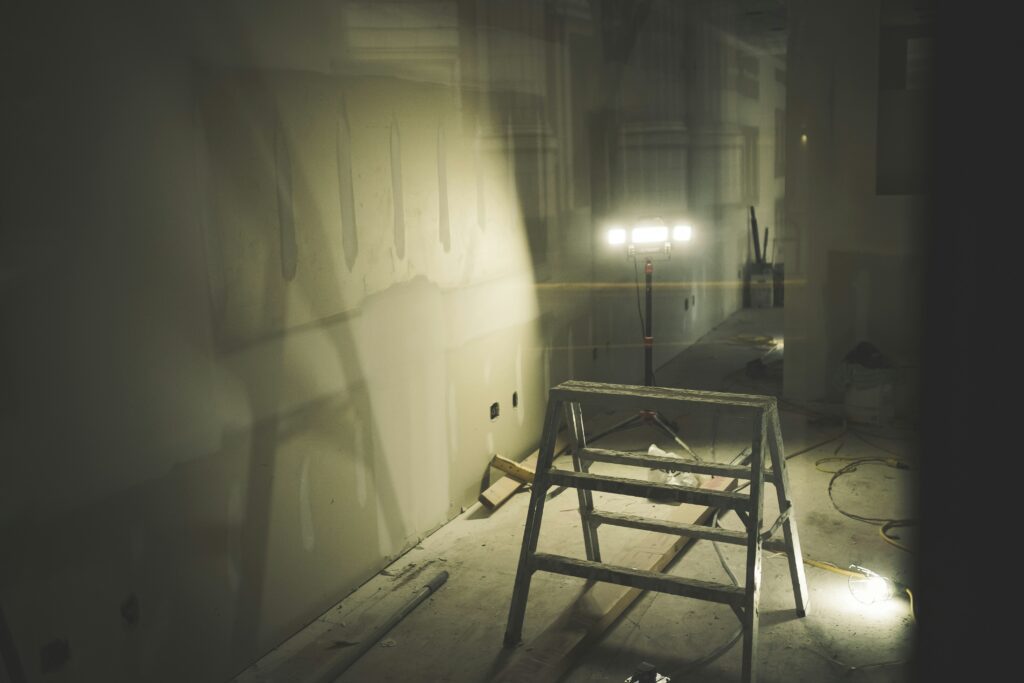
For a typical Calgary basement development — say 800 to 1,000 square feet — expect about 5 to 7 days from first coat to final sand. That’s not 5 days of labour; it’s 5 days of total time because each coat needs at least 24 hours to dry before the next one goes on. Calgary’s dry climate actually speeds things up compared to more humid cities, but we still won’t rush the drying between coats. Cracking from moisture trapped between layers is a real problem.
Absolutely. We do this pretty regularly — homeowners hang the board to save money, then bring us in for the taping and finishing. Just make sure your screws are set slightly below the surface (not poking out, not driven so deep they tear through the paper face) and your sheets are tight to each other at the seams. If there are gaps wider than about 1/8 inch, we’ll need to fill them with setting-type compound first, which adds time and cost. But yeah, we’re happy to finish what you started.
We use paper tape on almost everything. Mesh tape (the self-adhesive fibreglass stuff) is faster to apply, but it’s weaker on inside corners and more prone to cracking along flat seams over time. Paper tape embedded in wet compound creates a stronger bond. The one place mesh works well is on small patches and repair jobs where you need a quick embed. But for new construction taping? Paper tape, every time.
Most rooms, no. Level 4 — three coats with sanding — is the standard for residential living spaces, and it looks great under flat and eggshell paint. You’d want Level 5 if you’re using high-gloss paint, if the room has large windows that throw light across the walls at a sharp angle, or if you’re going for a very modern look where every imperfection matters. Hallways with end windows and feature walls with dramatic lighting are the most common places we do Level 5 in Calgary homes. It’s roughly 25–30% more labour, so worth doing where it counts but not necessarily everywhere.
Cost depends on the square footage, finish level, and complexity of the job. A standard basement development with Level 4 finish will cost less than a living room requiring Level 5. Ceiling height, the number of inside corners, and whether it’s new construction or a renovation all factor in. We don’t do ballpark guesses — we come look at the job and give you an honest number. Call us at (403) 969-0155 for a free quote on your mudding and taping project.