Residential Drywall & Stucco Services in Calgary
Residential Drywall & Stucco Services in Calgary
Here’s something you don’t see much in Calgary: a contractor who does both drywall and stucco. Most guys pick a lane. Interior drywall crews don’t touch the exterior. Stucco contractors don’t want anything to do with what’s happening inside your walls. RC Stucco and Drywall does both — and has for years.
That matters more than you’d think. Stucco and drywall share the same fundamental skills: understanding substrates, working with cementitious materials, managing moisture, and knowing how buildings move. When we’re stuccoing your exterior, we’re thinking about the same structural details we’d consider when finishing your interior walls. One company, one crew that understands your whole house — not just one side of it.
We handle full stucco applications on new builds, re-stucco jobs on existing homes, and everything from small patch repairs to full exterior restorations. If your Calgary home has stucco — or you want it to — we’re the call to make.
Traditional stucco (3-coat system). This is Portland cement, sand, and lime applied in three layers — scratch coat, brown coat, and finish coat. It’s the system that’s been used for decades and it’s what we recommend for most Calgary homes. Why? Because it’s hard, it’s durable, and it handles our freeze-thaw cycles better than the alternatives when installed over a proper drainage plane. The total wall thickness ends up around 7/8 inch. It’s heavy. It’s solid. And it lasts 50+ years when maintained.
Acrylic stucco. A polymer-modified finish that’s applied thinner than traditional stucco — usually over a base coat rather than the full 3-coat system. It comes in a wider range of colours than traditional stucco, stays flexible so it resists hairline cracking, and doesn’t need painting as often. The downside? It’s not as impact-resistant as Portland cement stucco, and it can trap moisture if the wall assembly behind it isn’t designed correctly. We use acrylic stucco where flexibility and colour options matter more than raw toughness.
Synthetic stucco / EIFS (Exterior Insulation and Finish System). This is a foam insulation board bonded to the exterior wall, covered with a fibreglass mesh and an acrylic finish coat. The insulation value is excellent — you can get R-5 to R-10 depending on foam thickness. But EIFS has a complicated reputation. In the 1990s and early 2000s, a lot of barrier EIFS systems trapped moisture behind the foam and caused serious rot damage to the sheathing underneath. Modern drainable EIFS systems fix this with a drainage plane and weep edges, but the installation has to be done right. No shortcuts. We install EIFS when it makes sense for the project, but we’re upfront about where the risks are and what it takes to manage them.
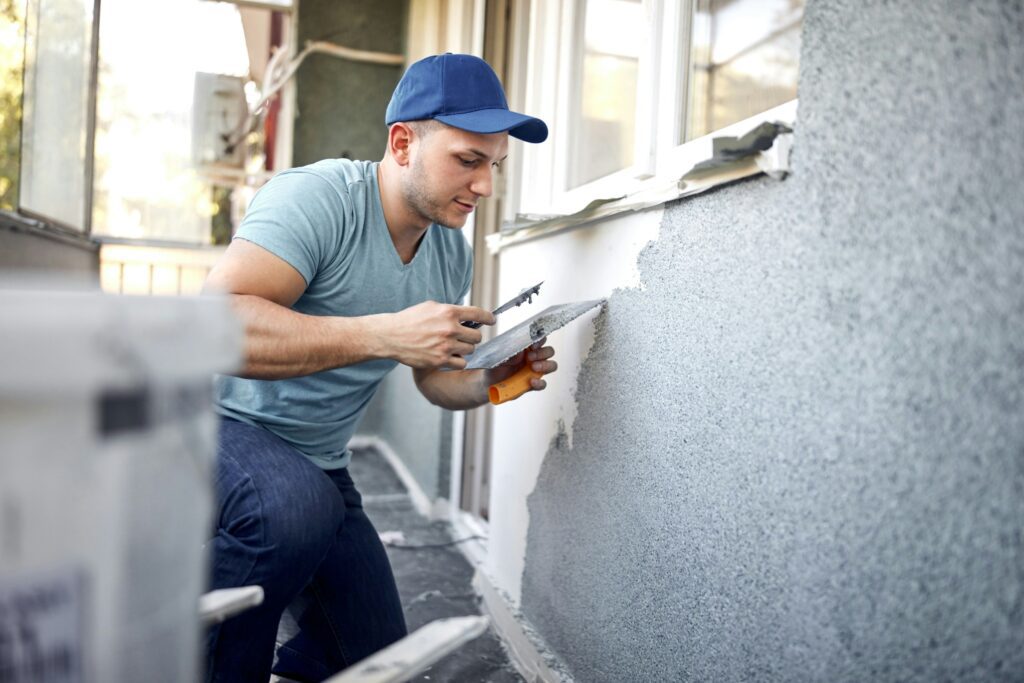
Stucco isn’t a one-day job. It’s a multi-step process where each layer needs time to cure before the next one goes on. Rushing any stage shows up later as cracks, delamination, or surface defects. Here’s how we do it:
Substrate preparation. This is where most stucco failures actually start — not in the finish coat, but in the prep. We install a weather-resistant barrier (building paper or house wrap) over the sheathing, then attach metal lath with corrosion-resistant fasteners. The lath gives the stucco something to grip. On wood-frame homes, we also install a drainage plane behind the lath so any moisture that gets behind the stucco has a path out. Skip this step and you’re asking for trouble in a Calgary winter.
Scratch coat. The first layer of cement-based stucco, applied about 3/8 inch thick and scored with horizontal grooves while it’s still wet. Those grooves give the next layer something to bond to. We keep the scratch coat damp for 24 to 48 hours so it cures properly rather than just drying out. There’s a difference — curing is a chemical reaction that needs moisture. Drying is just evaporation, and it weakens the bond.
Brown coat. Applied over the cured scratch coat, also about 3/8 inch thick. This is the layer that creates a flat, even surface. We float it smooth with a darby and straightedge. The brown coat needs to cure for at least 7 days — sometimes longer depending on conditions. We mist it periodically during that time to keep the curing process active.
Finish coat. The final layer that gives the wall its colour and texture. This is where you choose your look — smooth troweled, sand float, dash, lace, or any number of custom textures. The finish coat is thinner, usually about 1/8 inch, and it’s the one everyone sees. Get the first two layers right and this one goes on clean.
Calgary climate note: We can’t apply stucco when the temperature is below 5°C or when freezing temperatures are expected within 24 hours. Cement needs warmth to cure. Apply it in November and the water in the mix freezes before the cement sets — you get a weak, crumbly coat that fails by spring. Our stucco season in Calgary runs roughly May through October, depending on the year. Some warm Chinook weeks in April or November can extend that window, but we don’t gamble on weather.
People ask us this all the time: is stucco a good choice for Calgary? The short answer is yes — with conditions.
Stucco has been on Calgary homes for decades. Drive through Signal Hill, Tuscany, Hamptons, Scenic Acres, or pretty much any NW community built in the 1990s and 2000s — stucco everywhere. Head to newer areas like Mahogany, Cranston, or Nolan Hill and you’ll see it on plenty of new builds too. It’s not going anywhere because it works.
The freeze-thaw concern is the big one. Calgary goes through roughly 30 to 40 freeze-thaw cycles per year — more than most Canadian cities. That’s hard on any exterior material. But here’s what people get wrong: stucco itself handles freeze-thaw fine. The failures happen when moisture gets trapped behind the stucco with no way out. When the temperature drops, that trapped water freezes, expands, and pushes the stucco away from the wall. The stucco didn’t fail. The water management behind it did.
That’s why we’re so particular about the drainage plane, flashing details, and caulking around penetrations. A properly installed stucco system on a Calgary home handles our winters without issue. An improperly installed one starts showing cracks within two to three years.
On the upside, stucco offers solid insulation value. A traditional 3-coat system adds roughly R-0.2 per inch — modest on its own, but it also provides an air barrier that reduces drafts. EIFS takes this further with dedicated insulation board. And stucco is low maintenance compared to wood siding — no painting every 5 to 7 years, no rot, no warping.
We see the same issues on Calgary stucco homes over and over. Most of them trace back to either installation shortcuts or deferred maintenance.
Cracking. The most common call we get. Hairline cracks in stucco are cosmetic — they happen as the material cures and the house settles. But cracks wider than 1/16 inch, or cracks that run from window corners or door frames, usually mean the substrate is moving or the stucco was applied too thick in one pass. Freeze-thaw makes existing cracks worse every winter because water seeps in, freezes, and wedges the crack open a little more each cycle.
Moisture intrusion. This is the serious one. Water gets behind stucco at window sills, door headers, roof-wall intersections, and anywhere caulking has failed. Once it’s behind the stucco, it has nowhere to go if there’s no drainage plane. We’ve opened up walls where the sheathing was black with mold and the homeowner had no idea. Proper flashing at every penetration and a functioning drainage plane are non-negotiable.
Delamination. When stucco separates from the substrate — pulls away from the lath or brown coat — it sounds hollow when you tap on it. This usually means the lath wasn’t fastened properly, the scratch coat wasn’t scored well enough for the brown coat to bond, or the surface was too dry when the next coat went on. Once stucco delaminates, patching the surface doesn’t fix it. The loose section needs to come off and be redone from the lath out.
Efflorescence. Those white, chalky deposits that show up on stucco surfaces. It’s mineral salts being carried to the surface by moisture moving through the wall. It’s not structurally harmful, but it looks bad and it tells you there’s moisture moving through your stucco that shouldn’t be. Cleaning it off is easy — diluted vinegar or a muriatic acid wash. Finding and fixing the moisture source is the real job.
If you’re dealing with any of these, our stucco repair page covers what’s involved in fixing them.
For a traditional 3-coat stucco application, expect roughly $8 to $12 per square foot for materials and labour on a straightforward new application. Re-stuccoing an existing home costs more because of the demo and disposal of the old stucco. Acrylic and EIFS systems fall in a similar range depending on insulation thickness. Every home is different — we’ll give you an accurate quote after seeing the project.
Traditional Portland cement stucco lasts 50 to 80 years with basic maintenance. Acrylic finishes typically last 20 to 30 years before they need refreshing. The key is catching small cracks before water gets behind them. An annual visual inspection in spring — after the worst of the freeze-thaw cycles — is all it takes to stay ahead of problems.
It depends on the siding. We can apply stucco over concrete block, brick, and certain masonry surfaces directly. For wood-frame walls with vinyl or wood siding, the old siding needs to come off first. Stucco needs a solid, stable substrate — lath attached to sheathing over a weather barrier. Layering it over old siding creates bonding and moisture problems that show up fast.
June through September gives you the most reliable weather. May and October work too, but you’re watching forecasts closely and covering fresh stucco with insulated blankets on cold nights. We won’t start a stucco job if we can’t guarantee at least a week of above-5°C temperatures, including overnight lows. Frozen stucco is failed stucco — there’s no fixing it after the fact.
Whether you’re planning new stucco on a build, re-stuccoing a home that’s seen better days, or just need someone to look at damage and tell you what’s going on — we’re here. RC Stucco and Drywall handles stucco and drywall installation under one roof, which means your interior and exterior work stays coordinated from start to finish.
Call us at (403) 969-0155 for a free estimate. Or head to our contact page and tell us about your project — we’ll get back to you with next steps.